Free design proof on every custom order: no templates, no stock SKUs

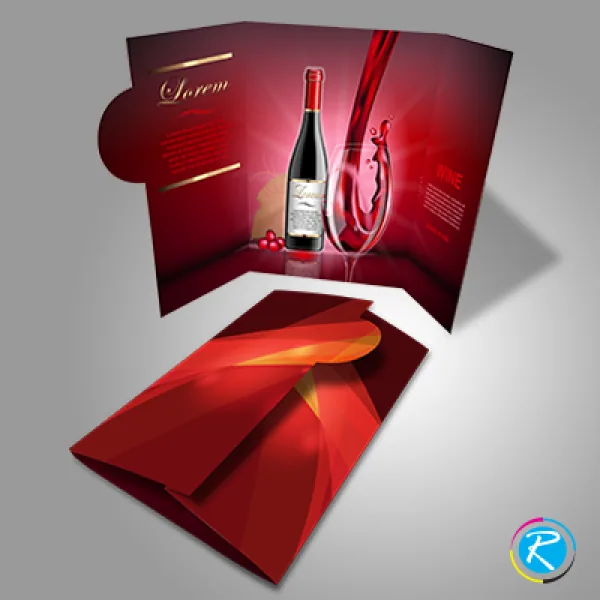
Legal brochures are printed on an 8.5 x 14 sheet (the same "legal" paper size used for legal-length documents) one size step up from a standard letter brochure but smaller than an oversized large-format piece. The extra length gives each panel more room for copy, which is why the format shows up often in insurance, legal, financial services and healthcare materials that need to say more than a standard tri-fold comfortably fits. It folds the same way a standard brochure does (tri-fold, half-fold or z-fold) just with taller panels.
An estimator will reply within one business day.
A legal brochure is printed on an 8.5 x 14 sheet. The same paper size courts and law offices use for legal-length documents, which puts it one step up from a standard 8.5 x 11 brochure without moving into an oversized 11 x 17 large-format piece. The extra three inches of length carry through to every panel once it's folded, so a tri-fold legal brochure has noticeably taller panels than a standard tri-fold while keeping roughly the same width.
That extra room per panel is the reason the format shows up so often in industries with more to disclose than a typical marketing piece: insurance policy summaries, financial services literature, legal and professional service overviews, and healthcare materials that need space for terms, definitions or fine print alongside the main message. Rather than shrinking type or cutting copy to fit a standard tri-fold, a legal brochure gives that content room to breathe without inflating the whole piece to a large-format size.
Folding options are the same as a standard brochure (tri-fold, half-fold, z-fold) and the choice comes down to how the content is organized. A tri-fold works well for a piece with a clear beginning, middle and end: an overview, then details, then a call to action or contact panel. A half-fold suits denser content that reads more like a folded document than a sequence of marketing panels, which fits the more formal tone legal brochures often carry.
Because it's still a folded piece rather than a bound booklet, a legal brochure works best when the content stays organized into clear sections per panel rather than running as one continuous block across the fold. A reader should be able to open to any panel and know roughly where they are. Paper stock runs the same range as a standard brochure, generally 80 lb to 100 lb text weight for a clean fold, with lamination available for pieces that need to hold up to repeated handling in a waiting room or filing environment. When ordering, confirm the panel count and reading sequence up front, since the taller format changes how content flows compared to a standard-size layout you may already have.
Brochure weight is a balance between feel and fold. Text weights around 130 to 170gsm fold crisply without scoring and suit anything distributed in volume. Heavier silk and cover weights feel more substantial and survive being carried in a bag, but they must be scored before folding or the coating cracks visibly along every fold. That scoring requirement is the practical dividing line in this family.
When does a brochure need scoring? From roughly 170gsm upward on coated stock. Skip it and the fold cracks white along its whole length on the first fold.
Full color on both sides is standard, since a brochure that is not printed on the reverse is a flyer. The consideration specific to this format is that the artwork has to be built as panels rather than as pages. Content that crosses a fold needs to allow for it, and any image spanning two panels has to survive being interrupted by a crease.
Can an image cross a fold? Yes, but keep faces and fine detail off the crease. A fold through the middle of a face is the classic brochure mistake.
The fold decides the reading sequence, which matters more than the panel count. A tri-fold reveals in thirds and hides the inside until fully opened. A bi-fold opens like a card to a single wide spread. A roll fold tucks each panel inside the next, so panels get progressively narrower and must be cut to allow for it. A gate fold opens from both sides to a center reveal.
Which fold should I choose? Describe the sequence you want the reader to experience rather than naming a fold, and we will tell you which one does it.
Gloss lifts photographic color and suits image-led brochures; matte and silk read calmer and are much easier on long copy, since gloss throws glare exactly where someone is trying to read. Lamination is worth it on cover-weight pieces that will be carried and re-read, because the fold is the first place an unprotected brochure starts to look worn.
Does the fold wear out? It is the first place to go. On anything kept and re-opened, a laminate or a silk finish makes a visible difference within weeks.
One size step up from letter, using the longer legal sheet. Folded into three that gives noticeably taller panels than a standard brochure without changing the width, so it still fits most racks while carrying substantially more content per panel. Folded into four it produces a slim, tall format that stands out precisely because it is unfamiliar.
Why choose legal over letter? More content per panel without losing rack compatibility. It is the cheapest way to get extra room without going to a bigger sheet.
Ask for samples before a long run. How a stock takes a fold is the property that decides whether a brochure looks crisp or cracked.
A blunt rule pressed into the sheet before folding so the fibers bend along a controlled line. On anything from roughly 170gsm upward on coated stock this is not optional. Without it the coating fractures white along every fold.
A bonded film, worth it on cover-weight brochures that get carried and re-opened. The fold is where an unprotected brochure fails first, and a laminate is what stops that happening within a fortnight.
Both cut glare so long copy stays readable under overhead light. On a text-heavy brochure this is a legibility decision rather than a stylistic one, gloss actively fights sustained reading.
A shaped edge, a die-cut window revealing the panel beneath, or an integral pocket for a loose insert. All three turn a folded sheet into something that does not read as a standard brochure at a glance.
Same family, genuinely different jobs. Your current selection is highlighted.
| Brochure | From | Sheet | Order it when |
|---|---|---|---|
| Standard Brochures | $220 | 8.5″ × 11″ sheet, folded | The default (fits racks and folders) |
| Legal Brochures | $290 | 8.5″ × 14″ sheet, folded | More content, still fits a rack |
| Large Brochures | $310 | 11″ × 17″ or larger sheet | Images need room to work |
| Custom Brochures | $220 | Your sheet, fold and panels | No standard sheet or fold fits |
More content per panel without losing rack compatibility. The panels get taller while the width stays the same. It is the cheapest way to buy extra room, and most people do not realise it is an option.
Folded into three, yes, since the panel width is unchanged from a letter brochure. It will sit taller in the slot, which is usually an advantage for visibility.
Three gives generous, tall panels and reads conventionally. Four produces a slim vertical format that stands out precisely because it is unfamiliar, at the cost of narrower panels for copy.
Somewhat, since it uses more paper and may sit less efficiently on the press sheet. The difference is usually smaller than the gain in usable space, but ask for both quoted if budget is tight.
Pricing for legal brochures starts at $290 and moves with quantity, size, material and finish rather than sitting on a fixed list. Setup is shared across the run, so the per-unit price drops steeply as the quantity rises: the gap between a few hundred and a few thousand is usually the significant one. Send the size, quantity and what it has to do and you get a firm figure back, not a range.
There is a practical minimum rather than a hard one. Every run carries artwork checks, a proof and a press setup, so a very small quantity of legal brochures prices poorly per unit even though we will still make it. If you are ordering a small batch, ask for pricing at two or three quantities at once: the curve usually shows that a modest increase costs very little more in total.
The clock starts when you approve the proof, not when the order is placed, which is the part most people are surprised by. You get a proof first: a digital proof showing the flat sheet with fold lines, plus the panel sequence in reading order. On a roll fold the proof also shows the stepped panel widths, since those panels are deliberately not equal. Turnaround after approval depends on the finish: anything laminated, foiled or die-cut adds a stage that cannot be compressed without causing problems later. Tell us the date you actually need them and we will work backwards from it rather than quoting a generic lead time.
Print-ready artwork with bleed and a safe margin, supplied as a PDF, AI or EPS. Photographic elements should be supplied at the resolution the finished size needs, not the resolution that looks sharp on screen. If your file is not print-ready, say so when you order. We would rather fix it before the proof than after the run.
Yes. 8.5″ × 14″ sheet is the standard build, and the dimensions around it are yours to set. A size that sits efficiently on the press sheet often costs no more than a standard one, while an awkward proportion that wastes half the sheet does. Ask before you commit and we will tell you whether a small change to the dimensions saves a disproportionate amount.
In most cases they are the same product under a different name: the trade uses several terms for it depending on the region and the supplier. What actually defines this one is the build: 8.5″ × 14″ sheet, folded. Order it when more content, still fits a rack. If you have seen it called legal brochures printing elsewhere, describe what it has to do rather than which name you found, and we will match the specification.
Yes. We provide free samples, and on legal brochures it is worth asking for one, because the difference between text weight gloss and text weight silk is obvious in the hand and invisible on a screen. Most orders run on text weight gloss, but ask for whichever you are weighing up. You also get a free design proof before anything goes to press, so nothing is printed that you have not seen.
The usual choices are scoring, lamination, silk and matte finishes. Finish is not decoration on this product so much as a decision about how long it survives and how it reads in the hand, so it is worth choosing against the job rather than the budget. Tell us where the finished piece ends up and we will say which finish is doing real work and which is only adding cost.
Yes, and that is what almost every order here is. Nothing in this catalogue is a stock item: legal brochures are manufactured to the specification you give us, with your artwork on them. Send your logo as vector artwork where you have it, since that scales to any size without softening. If all you have is a low-resolution file, tell us and we will say what it needs before it reaches the press.
Yes, and a repeat run is simpler than the first one. We keep your approved specification on file, so a reorder skips the setup decisions and goes straight to production. If nothing about the artwork or the specification has changed, there is nothing to re-approve. Tell us the previous order and we will match it rather than starting the specification again.
Yes. Regalo Print has been producing custom commercial print for businesses across the USA and Canada since 2008, and every order ships tracked. The tracking number reaches you the day the job leaves, not the day it arrives. If you are working to a fixed date, say so when you order so the production schedule is built around the delivery date rather than the other way round.