Free design proof on every custom order: no templates, no stock SKUs
The widest range on the site, and most of it is one decision repeated: what the sticker is made of. Paper indoors, vinyl anywhere it might get wet or sunlit, and a handful of speciality faces (reflective, fluorescent, clear, foam, resin) each chosen for one specific effect. Filter by where it has to live.
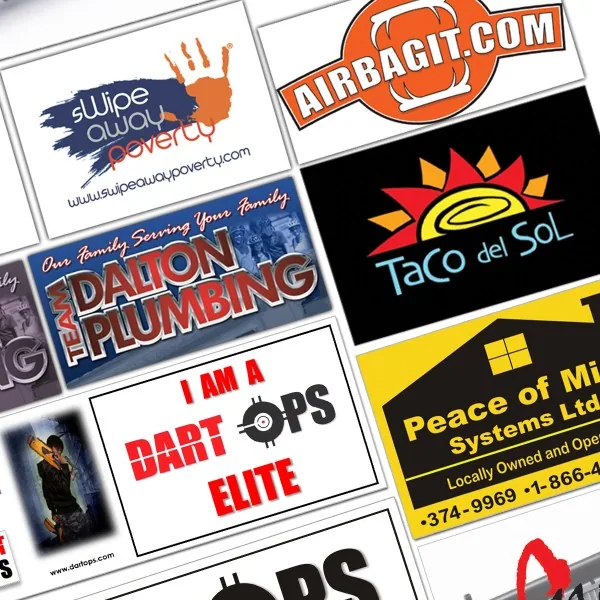
White vinyl, laminate, permanent, the general-purpose outdoor sticker.

Every layer specified, nothing standard fits the job.

Cut to a custom outline. The shape is the artwork, not a rectangle.

Transparent film, white underbase, no visible border on glass.

Outdoor vinyl, UV ink and laminate. It lives outside for more than a season.

Outdoor vinyl, automotive adhesive. It goes on a vehicle and stays there.

Build follows the vehicle surface, vehicle graphics beyond the bumper strip.

Inside reverse or outside face print. It is read through glass.

Glass-bead retroreflective sheeting. It has to be seen at night.

Dayglo base stock. Nothing in CMYK is bright enough.

Foam laminate under the face: a raised, tactile indoor sticker.

Circular die, any material (shape choice) nothing to catch and lift.

Oval die, any material. Artwork wider than it is tall.

Square cut, radius optional, most efficient shape on the sheet.

Gang run, kiss cut, standard sizes. Volume matters more than flexibility.

High-contrast, permanent, outdoor. It is a warning, not a decoration.

Small seal, foil optional, marking a milestone or an edition.
E-flute board, high-tack, shelf and display pieces with real thickness.

Backing, vinyl, transfer tape. Multi-piece artwork must land aligned.

Removable adhesive. It has to come back off cleanly.

Thin conformable vinyl, hard-plastic adhesive. It sits on a curved helmet shell.

Cut colored vinyl, no print: type alone, no background panel.

Perforated black-backed film: a graphic outside, a view from inside.

Tear line through the face (part of it detaches) seal, coupon, tab.

Kiss cut on a carrier sheet. It ships attached to a mailer.

Cut vinyl, unprinted, transferred, type or a logo with no background at all.

Supplied between two peels. Separated artwork must transfer as one.
Almost every sticker decision comes back to the face material. If it will ever be rained on, left in sun, or wiped with anything, it needs a vinyl face and a laminate over it. An unlaminated vinyl sticker fades visibly in a single strong summer, and reds and blues go first. Indoors, on a box or a folder, for one season, paper does the same job for noticeably less. Nothing else in the specification rescues the wrong material choice.
The speciality faces are each solving one problem and are not interchangeable. Reflective sheeting is for being seen under headlights; fluorescent stock for daylight visibility that no CMYK mix can reach; clear film for artwork that should float on glass with no visible border; foam for a raised, tactile finish indoors. Shape is a separate axis from all of it. Round, oval and rectangular are cuts, not materials, so any of them can be ordered on any face above.