Free design proof on every custom order: no templates, no stock SKUs
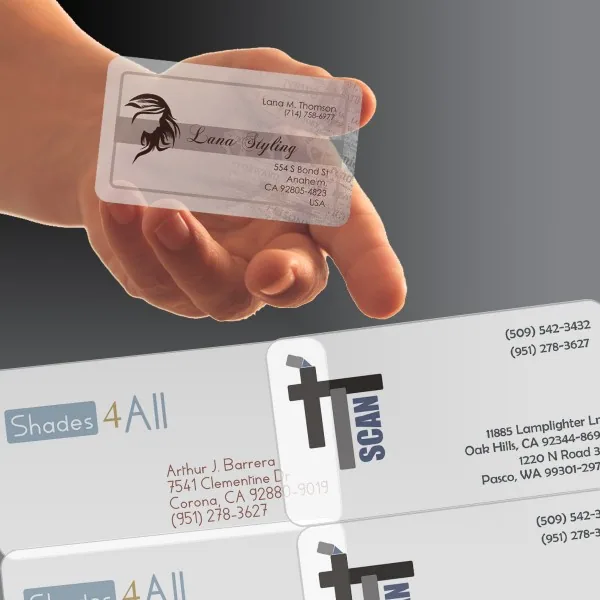
Plastic business cards are printed on durable PVC stock instead of paper, giving them a rigid, waterproof feel that survives a wallet, a gym bag or a rainy handoff without bending or tearing. Available in frosted, clear or solid opaque finishes, with the option to print white ink for full-color artwork on a clear or dark card. A strong pick for brands that want a card to feel unmistakably premium, or for membership, loyalty and access cards that need to hold up to daily handling.
An estimator will reply within one business day.
Plastic business cards trade standard cardstock for PVC (the same durable, flexible plastic used in gift and membership cards) and the material change is the whole point. A paper card, even a heavy 32 pt stock, will eventually soften, crease or wear at the corners with regular handling. A PVC card holds its shape, resists water and doesn't tear, which makes it a natural fit for anyone whose card gets carried daily in a wallet or bag rather than filed away after one meeting, and for use cases like membership or loyalty cards where physical durability is the actual requirement, not just a nice-to-have.
The stock itself comes in a few base finishes that change how a design reads. Frosted PVC has a soft, translucent, slightly matte look that gives colors a muted, premium quality. It's a popular choice specifically because it doesn't look like a standard printed card at first glance. Clear PVC is fully transparent and works well for a minimalist design where the see-through material itself is the visual statement, though it requires white ink underprinting for any color or text to show up opaque against whatever's behind the card. Solid opaque plastic in white, black or a custom color functions closest to a traditional card while keeping the rigidity and water resistance of the material.
Because standard process inks won't show up on a clear or dark plastic surface the way they do on white paper, printing on plastic cards typically involves a white ink base layer printed first, with the full-color design layered on top. This is what allows a design to read cleanly on a black or transparent card rather than looking washed out. Rounded corners are common on plastic cards, both because they reduce the risk of the sharper edges catching on pockets or wallets and because they reinforce the more polished, less paper-like feel the material already has.
Plastic cards make the most sense in a few specific situations: a brand that wants its card itself to signal quality before anyone reads it, a business issuing membership, loyalty or access cards that need to survive months of daily use, or any card design built around transparency or an unconventional finish that paper simply can't replicate. For a standard giveaway card handed out in bulk at a low cost per unit, paper stock remains the more practical choice. Plastic earns its higher per-card cost specifically through durability and a distinct in-hand feel.
Card weight is the first thing anyone judges without knowing they are judging it. 14pt is the common baseline and reads as ordinary; 16pt is where a card starts to feel substantial in the hand; 18pt and above feels deliberate, and is heavy enough that people notice it as a decision rather than a default. Plastic and translucent stocks leave the paper scale entirely and are judged on rigidity instead.
Does anyone actually notice the weight? Not consciously, but a flimsy card gets filed as disposable in about a second, and that judgment happens before anyone reads it.
Full color on both sides is the norm and costs little more than one side, since the sheet passes through anyway. The decisions that matter are color accuracy and coverage: a brand color that must match across reprints runs as a Pantone spot rather than being mixed from process inks, and heavy solid coverage across a full card shows every handling mark unless it is protected by the right finish.
Should I print the back? Almost always. The cost difference is small and the reverse is the only space you have for anything beyond a name and a number.
A coating protects the card and sets its character. Gloss maximizes color and wipes clean but shows fingerprints and cannot be written on. Matte reads as more restrained and photographs without glare. Soft-touch is a matte film with a velvety surface that is the single most commented-on finish in this family. Uncoated takes pen, which matters more than people expect, because cards get written on.
Will people write on my card? Often. A meeting date, a note, a different number. On gloss or soft-touch, ink sits on the surface and smears. Leave an uncoated panel if that matters.
A standard card is guillotined square, which leaves a clean 90-degree corner and a cut edge showing the stock. From there the edge becomes a design surface in its own right: corners can be rounded on a die, edges can be painted in a contrasting color, and two or three sheets can be bonded so the card shows a colored core when viewed edge-on.
Why round the corners? Partly appearance, partly wear. A square corner is the first thing to bend in a wallet, and a bent corner makes a new card look old.
Printed on PVC rather than paper, which changes the object entirely: it is waterproof, it does not soften or fray at the corners, and it survives a wallet, a toolbag or a wet hand indefinitely. The rigidity is what people react to. A plastic card feels closer to a payment card than to print, which is exactly why it is chosen for trades, memberships and anything meant to be kept rather than filed.
Can plastic cards be written on? Not with an ordinary pen. The surface is non-porous. If someone needs to write on it, ask for a signature panel, which is a printed area that will take ink.
Ask for samples before committing. Weight and surface are the two things a card is judged on, and neither survives a screen.
Gloss for color saturation and wipe-clean durability; matte for a restrained surface that photographs without glare. Either one roughly doubles how long a card survives a wallet before the corners soften.
A matte film with a velvety surface. It is the finish people comment on unprompted more than any other, and it is also the one that marks most easily. A trade worth making on a card handed over deliberately.
A raised gloss varnish on selected elements, or metallic foil pressed into the stock. Against a matte or soft-touch ground both create contrast you can feel as well as see, which is why they are usually applied to a logo rather than to type.
Rounded corners, painted edges in a contrasting color, or a colored core layer showing between two printed faces. All three work on the one surface most cards ignore entirely.
Same family, genuinely different jobs. Your current selection is highlighted.
| Card | From | Format | Order it when |
|---|---|---|---|
| Standard Business Cards | $100 | 3.5″ × 2″, any stock and finish | It has to fit every wallet, every time |
| Folded Business Cards | $100 | Center score, four panels | Contact details are not the only content |
| Plastic Business Cards | $120 | Rigid PVC, waterproof | It has to survive a wallet or a worksite |
| Translucent Business Cards | $110 | Frosted semi-transparent PVC | The card itself should be the talking point |
| Custom Business Cards | $160 | Square, shaped or die-cut | The rectangle is the thing you want to break |
Not with an ordinary pen. The surface is non-porous and ink beads or smears. If someone needs to write on it, ask for a printed signature panel, which is a treated area that will take ink.
If the card is meant to be kept rather than filed, usually. They survive wallets, toolbags and weather indefinitely, and the rigidity reads closer to a payment card than to print, which is most of why people hold on to them.
Not through ordinary paper streams, no. PVC is a plastic and has to be treated as one. If recyclability matters to your brand, a heavy uncoated card is the more consistent choice.
Usually, and for a practical reason. A square corner on rigid PVC is genuinely sharp and catches in pockets. Rounding is standard rather than an upgrade on this stock.
There is a practical minimum rather than a hard one. Every run carries artwork checks, a proof and a press setup, so a very small quantity of plastic business cards prices poorly per unit even though we will still make it. If you are ordering a small batch, ask for pricing at two or three quantities at once: the curve usually shows that a modest increase costs very little more in total.
The clock starts when you approve the proof, not when the order is placed, which is the part most people are surprised by. You get a proof first: a digital proof showing artwork against the trim and safe lines, with any spot color, foil or spot UV areas marked as separate layers so you can see exactly what is being treated. Turnaround after approval depends on the finish: anything laminated, foiled or die-cut adds a stage that cannot be compressed without causing problems later. Tell us the date you actually need them and we will work backwards from it rather than quoting a generic lead time.
Print-ready artwork with bleed and a safe margin, supplied as a PDF, AI or EPS. Photographic elements should be supplied at the resolution the finished size needs, not the resolution that looks sharp on screen. If your file is not print-ready, say so when you order. We would rather fix it before the proof than after the run.
Yes. Rigid PVC, waterproof is the standard build, and the dimensions around it are yours to set. A size that sits efficiently on the press sheet often costs no more than a standard one, while an awkward proportion that wastes half the sheet does. Ask before you commit and we will tell you whether a small change to the dimensions saves a disproportionate amount.
In most cases they are the same product under a different name: the trade uses several terms for it depending on the region and the supplier. What actually defines this one is the build: rigid pvc, waterproof. Order it when it has to survive a wallet or a worksite. If you have seen it called plastic business cards printing elsewhere, describe what it has to do rather than which name you found, and we will match the specification.
Yes. We provide free samples, and on plastic business cards it is worth asking for one, because the difference between 14pt c2s and 16pt c2s is obvious in the hand and invisible on a screen. Most orders run on 16pt c2s, but ask for whichever you are weighing up. You also get a free design proof before anything goes to press, so nothing is printed that you have not seen.
The usual choices are lamination, soft-touch, spot uv and foil. Finish is not decoration on this product so much as a decision about how long it survives and how it reads in the hand, so it is worth choosing against the job rather than the budget. Tell us where the finished piece ends up and we will say which finish is doing real work and which is only adding cost.
Yes, and that is what almost every order here is. Nothing in this catalogue is a stock item: plastic business cards are manufactured to the specification you give us, with your artwork on them. Send your logo as vector artwork where you have it, since that scales to any size without softening. If all you have is a low-resolution file, tell us and we will say what it needs before it reaches the press.
Yes, and a repeat run is simpler than the first one. We keep your approved specification on file, so a reorder skips the setup decisions and goes straight to production. Where the job used custom tooling, that tooling is reused, which is why a shaped run costs less the second time. Tell us the previous order and we will match it rather than starting the specification again.
Yes. Regalo Print has been producing custom commercial print for businesses across the USA and Canada since 2008, and every order ships tracked. The tracking number reaches you the day the job leaves, not the day it arrives. If you are working to a fixed date, say so when you order so the production schedule is built around the delivery date rather than the other way round.