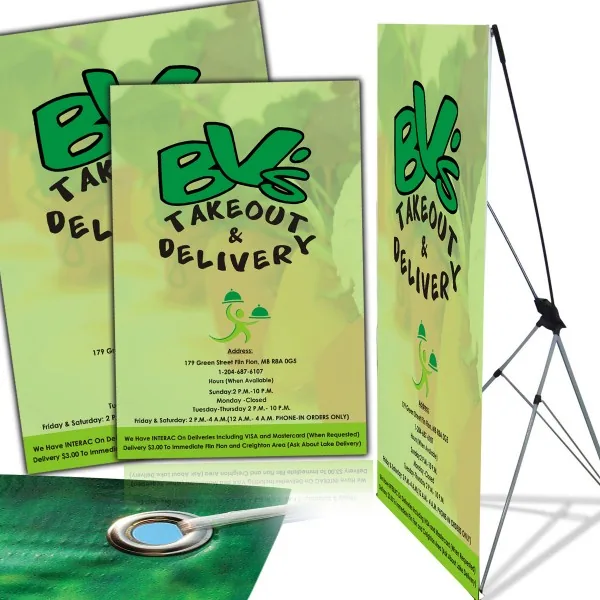
Free design proof on every custom order: no templates, no stock SKUs
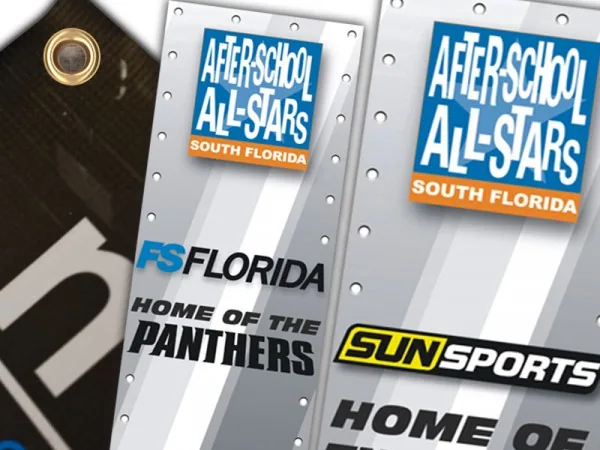
Vinyl banners are the standard for outdoor signage: heavy-duty scrim vinyl printed in full color, finished with hemmed edges and grommets so it can be tied, zip-tied or bolted to a fence, wall or stand. Waterproof and UV-resistant, the material holds up through a season of sun and rain without breaking down. The default choice for anything that needs a straightforward, durable banner rather than a specialty finish.
An estimator will reply within one business day.
A vinyl banner is built from scrim vinyl (a woven polyester mesh core laminated between layers of PVC) which is what gives it both strength and flexibility. The scrim keeps the material from stretching or tearing under wind load, while the PVC coating makes it waterproof and resistant to UV fading, dirt and general outdoor wear. Most banners use a 13oz weight, a middle ground that handles typical outdoor conditions without the added cost of a heavier-duty stock meant for extreme, long-term exposure.
Finishing is standardized for a reason: hemmed edges reinforce the perimeter so the material doesn't fray at the cut line, and grommets are set at consistent intervals, typically every two feet, along whichever edges need to bear weight or tension. That combination is what lets a vinyl banner get tied, zip-tied, bolted or hung from nearly any structure (a chain-link fence, a wall, a set of stands, a scaffold) without special hardware or a custom mounting solution.
Because it's durable, weatherproof and works with almost any mounting method, vinyl is the default choice across the widest range of banner uses: grand openings and store sales, real estate signage, sports team and school event banners, political and campaign signage, construction site notices, and trade show or event backdrops. It's the banner material to reach for when nothing about the situation calls for a specialty option. No need for wind permeability like mesh, no need for adhesive mounting like a sticky banner, just a straightforward sign that needs to hold up outdoors.
Printing is full color on one side by default, with double-sided printing available for a banner that needs to be read from both directions. Hanging across a walkway or strung between two points where it's visible from either side. Single-sided printing is the standard, lower-cost option for anything mounted flat against a wall, fence or backdrop where only one face will ever be seen.
Sizing runs from small event signage up to oversized banners spanning a storefront or building face, with the material itself imposing no real upper limit. What matters more than the maximum size is matching the finished dimensions to the viewing distance: text and graphics sized for someone reading from ten feet away won't hold up the same at fifty, so it's worth thinking through where the banner will actually be seen from before finalizing layout and size.
Banner material is chosen against wind and location before anything else. Scrim vinyl is a heavy PVC with a woven polyester grid laminated inside it. The grid is what stops a tear spreading across the whole banner once one starts. Mesh perforates that material so air passes through. Adhesive-backed material has no hanging hardware at all and mounts flat to a surface.
Why does scrim matter? The internal grid stops a small tear becoming a long one. It is the difference between a banner that survives a gust and one that splits end to end.
Banners are read from further away than any other printed piece, and that governs the design far more than resolution does. Type sized for a poster disappears at thirty feet. The useful discipline is to decide the reading distance first, size the largest element to be legible at it, and accept that everything else is secondary. A banner carrying three lines of small text is a banner nobody reads.
How much text can a banner carry? One message and one identifier, in practice. Anything more is being read by people already standing still, and they are not who a banner is for.
Every edge is finished, because a raw cut edge on a hanging banner is where failure begins. A hem folds the material back on itself and welds it, doubling the thickness where the stress concentrates. Reinforcement webbing adds a woven strip inside the hem for large or exposed banners. Adhesive and indoor banners often need no hem at all, since nothing is pulling on them.
Do I need hemmed edges? Outdoors, always. The hem is what stops wind working into an edge and progressively tearing the banner apart.
How it attaches decides how long it survives. Grommets (metal rings punched through the hem) are the standard, spaced closer on larger banners so load is shared rather than concentrated. Pole pockets are sewn channels for a rod at top and bottom, which suits hanging banners that must stay flat. Adhesive backing removes hardware entirely for flat surfaces.
How far apart should grommets be? Closer than most people assume on anything large or exposed. Too few grommets concentrates the whole wind load onto two or three points.
The standard outdoor banner: heavy scrim vinyl, full-color print, welded hems all round and grommets at the corners and along the edges. It is a solid sheet, so it takes the full force of any wind that hits it, which is fine on a wall or a fence where there is nothing to catch, and is exactly the situation mesh exists for when there is.
Will it survive outside? Yes, for seasons rather than weeks, provided it is mounted with enough grommets and is not free-standing in strong wind.
Tell us where it hangs before choosing a material. Wind exposure decides this list far more than appearance does.
The edge folded back and heat-welded, doubling material thickness where stress concentrates. On any outdoor banner this is structural rather than cosmetic. An unhemmed edge is where wind starts working the banner apart.
Metal rings punched through the hem for rope or ties. Spacing matters more than count: on large or exposed banners they go closer together so load is shared rather than concentrated on a few points.
Sewn or welded channels along the top and bottom for a rod or pole. They keep a hanging banner flat and are the usual choice where it hangs free rather than being tied to a fence.
Webbing sewn inside the hem for large banners, and an opaque blockout core where both sides are printed and neither should show through the other.
Same family, genuinely different jobs. Your current selection is highlighted.
| Banner | From | Material | Order it when |
|---|---|---|---|
| Vinyl Banners | $75 | Solid scrim, hemmed and grommeted | The standard outdoor banner |
| Mesh Banners | $135 | Perforated, wind passes through | Fences, scaffolding and exposed sites |
| Sticky Banners | $150 | Adhesive backed, no hardware | Glass, walls and stage fronts |
| Custom Banners | $150 | Your size, material and mounting | The space does not fit a standard |
Seasons rather than weeks, provided it is mounted properly. What kills banners early is almost never the material. It is too few grommets concentrating wind load, or an unhemmed edge that wind gets into and works apart.
More than most people order. On anything large or exposed they should be close enough that no single point takes a disproportionate share of the load. Tell us the size and the location and we will space them for it.
13oz covers the large majority of banners and is the standard for good reason. 18oz is worth it for long-term installations and heavily exposed sites where the extra weight and thickness genuinely buy longevity.
Yes, with a blockout core so neither side shows through the other. Without blockout, a double-sided print on standard vinyl produces a visible ghost of the reverse image.
Pricing for vinyl banners starts at $75 and moves with quantity, size, material and finish rather than sitting on a fixed list. Setup is shared across the run, so the per-unit price drops steeply as the quantity rises: the gap between a few hundred and a few thousand is usually the significant one. Send the size, quantity and what it has to do and you get a firm figure back, not a range.
There is a practical minimum rather than a hard one. Every run carries artwork checks, a proof and a press setup, so a very small quantity of vinyl banners prices poorly per unit even though we will still make it. If you are ordering a small batch, ask for pricing at two or three quantities at once: the curve usually shows that a modest increase costs very little more in total.
Print-ready artwork with bleed and a safe margin, supplied as a PDF, AI or EPS. Photographic elements should be supplied at the resolution the finished size needs, not the resolution that looks sharp on screen. If your file is not print-ready, say so when you order. We would rather fix it before the proof than after the run.
Yes. Scrim vinyl, hemmed and grommeted is the standard build, and the dimensions around it are yours to set. A size that sits efficiently on the press sheet often costs no more than a standard one, while an awkward proportion that wastes half the sheet does. Ask before you commit and we will tell you whether a small change to the dimensions saves a disproportionate amount.
In most cases they are the same product under a different name: the trade uses several terms for it depending on the region and the supplier. What actually defines this one is the build: solid scrim, hemmed and grommeted. Order it when the standard outdoor banner. If you have seen it called vinyl banners printing elsewhere, describe what it has to do rather than which name you found, and we will match the specification.
Yes. We provide free samples, and on vinyl banners it is worth asking for one, because the difference between 13oz scrim vinyl and 18oz scrim vinyl is obvious in the hand and invisible on a screen. Most orders run on 13oz scrim vinyl, but ask for whichever you are weighing up. You also get a free design proof before anything goes to press, so nothing is printed that you have not seen.
The usual choices are welded hems, grommets, pole pockets. Finish is not decoration on this product so much as a decision about how long it survives and how it reads in the hand, so it is worth choosing against the job rather than the budget. Tell us where the finished piece ends up and we will say which finish is doing real work and which is only adding cost.
Yes, and that is what almost every order here is. Nothing in this catalogue is a stock item: vinyl banners are manufactured to the specification you give us, with your artwork on them. Send your logo as vector artwork where you have it, since that scales to any size without softening. If all you have is a low-resolution file, tell us and we will say what it needs before it reaches the press.
Yes, and a repeat run is simpler than the first one. We keep your approved specification on file, so a reorder skips the setup decisions and goes straight to production. If nothing about the artwork or the specification has changed, there is nothing to re-approve. Tell us the previous order and we will match it rather than starting the specification again.
Yes. Regalo Print has been producing custom commercial print for businesses across the USA and Canada since 2008, and every order ships tracked. The tracking number reaches you the day the job leaves, not the day it arrives. If you are working to a fixed date, say so when you order so the production schedule is built around the delivery date rather than the other way round.