Free design proof on every custom order: no templates, no stock SKUs
The #9 envelope, 3.875" x 8.875", is sized specifically to nest inside a #10 envelope, which is why it's best known as a return or reply envelope rather than an outer mailing envelope on its own. Businesses insert a #9 pre-addressed to themselves, often with an account or reference number printed on it, so a customer can drop a payment or response straight back in the mail. It's a mainstay of invoice remittance, donation appeals, subscription renewals and any mailing built around a "reply requested" structure.
An estimator will reply within one business day.
Envelope sizing in North America follows a numbered system originally set up for banking and office correspondence, and the #9 sits one size below the #10 for a specific reason: at 3.875" x 8.875", it's small enough to slide inside a #10 envelope with room to spare. That relationship is the whole point of the size. Rather than functioning as a standalone mailing envelope, the #9 is almost always the return envelope tucked inside a larger outgoing piece.
The typical use case runs in one direction: a business sends a #10 envelope containing a letter, invoice or appeal, and encloses a #9 already addressed and often stamped or marked for postage, ready for the recipient to use for their reply. Because the sender fills in their own return address ahead of time, the recipient only needs to add whatever's being returned, a check, a signed form, a donation, and drop it back in the mail. This is why the #9 shows up constantly in utility bills, medical statements, insurance renewals, nonprofit fundraising mail and subscription services: anywhere a business wants to make responding as frictionless as possible.
Because a #9 envelope is rarely seen without its companion #10, the two are commonly ordered together and designed to match. Same paper stock, same printed elements, and return addresses that are consistent between the outer and inner envelope. A window can be added to a #9 as well, letting a pre-printed remittance slip's address show through so nothing needs to be handwritten before it's dropped in the mail. Some #9 envelopes also include a small printed line for an account or reference number, letting a business match incoming replies back to the original mailing without extra tracking.
When ordering, it's worth deciding early whether the #9 needs a window, what closure type suits the expected volume (self-seal envelopes speed up outbound stuffing considerably), and whether any pre-printed instructional text, "return this envelope with payment," for instance, should be included on the front.
Envelope weight is doing two jobs: it decides how the piece feels when it arrives, and it decides whether the contents show through. A 24lb wove is the everyday business standard and hides a folded letter adequately. Step up to 28lb or 32lb where the contents are thicker, where a check or a dark-printed insert would otherwise ghost through, or where the envelope itself is meant to signal that something considered is inside.
Why can I see the contents through my envelopes? The stock is too light for what is inside. Either move up a weight or add a printed security tint to the interior.
The constraint that surprises people is that you cannot print wherever you like. Postal systems reserve areas of the face for the address block, the postmark and machine-readable barcodes, and artwork intruding on them can slow a mailing down or get it rejected. Everything else is available (the flap, the reverse, and the areas of the face outside those zones) which is why so much envelope design lives on the back.
Can I print across the whole front? No. The address block, postmark area and barcode zone have to stay clear. We will show those on your proof.
How the envelope is folded and glued determines what it is good at. A side-seam envelope has glue lines up both edges and lies flat and rigid, which is what business correspondence and machine insertion need. A diagonal-seam envelope folds from a single diamond blank with the seams meeting in the middle. Traditionally the more formal construction, and the one used for invitations and announcements.
Does the seam matter? For machine inserting, yes. Side seam feeds reliably. For a hand-addressed invitation, diagonal seam simply looks right.
Three closures, chosen against volume and by hand or by machine. Gummed flaps need moisture and are the cheapest. Fine for a machine, tedious by hand in quantity. Peel-and-seal has a release strip over a pressure adhesive and is far faster for hand assembly. Latex self-seal bonds only to itself, so envelopes can be stacked without sticking and closed with a press.
Which for a hand-stuffed mailing? Peel and seal, without hesitation. The extra cost per envelope is recovered in the first hundred you do not have to lick.
At 3.875″ × 8.875″ this is deliberately a few millimeters smaller than a #10 in both directions, so it drops inside one without being forced or folded. That single relationship is the entire reason the size exists: it is the reply envelope you enclose with an invoice, a remittance request or a donation appeal, and it is almost never used as an outer envelope.
Can I use a #9 as an outer envelope? You can, but it is unusual enough that recipients read it as a reply envelope. If it is going out as primary mail, use a #10.
Ask for samples before committing. Show-through and how a stock takes a fold are both impossible to judge on screen.
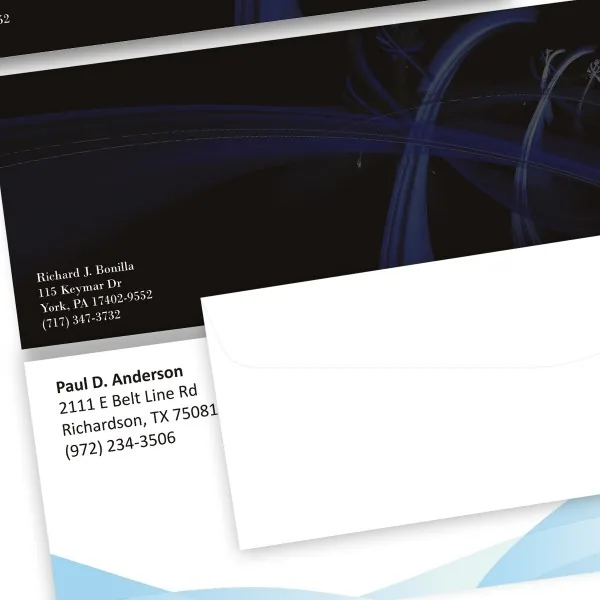
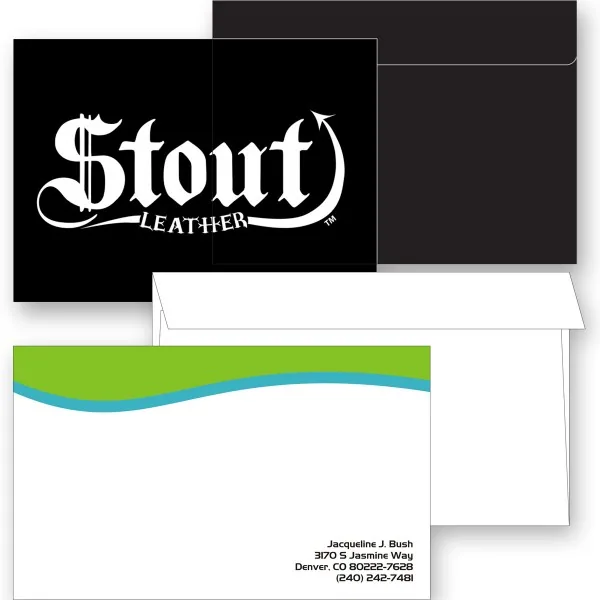
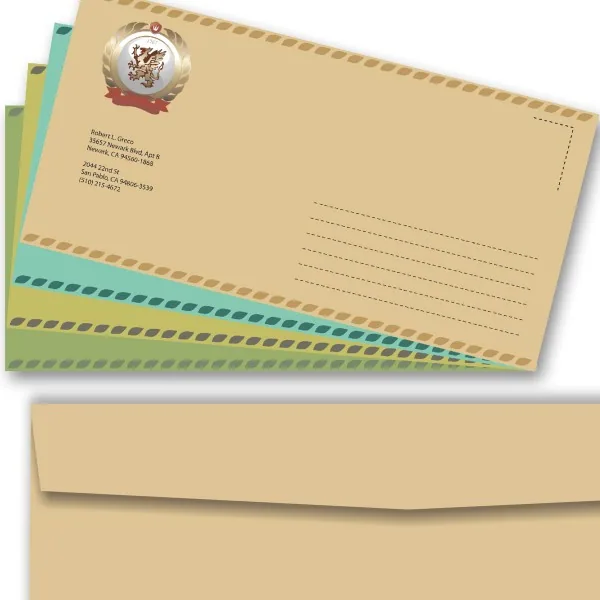
A return address and a logo, printed directly. It is the cheapest way to make mail look like it came from an organization rather than from a printer, and on a business envelope it is often all that is needed.
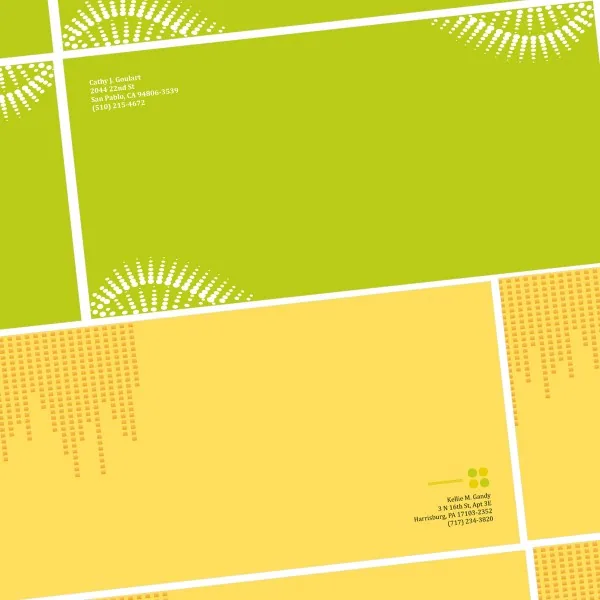
Photographic and full-bleed artwork. Worth noting that full-bleed coverage is only truly achievable on custom envelopes printed flat before converting. On a pre-made envelope the seams and flap edges limit how far ink can reach.
Metallic foil pressed into the stock, most often on the flap or as a monogram. On a textured or laid envelope the combination of foil against the ribbed surface is the traditional formal treatment.
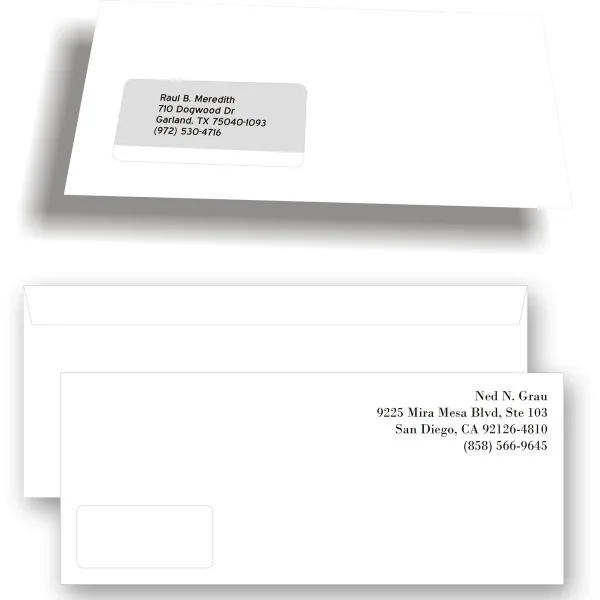
A die-cut aperture backed with a clear film so an address prints once, on the letter, and shows through. It removes a whole addressing step from a mailing, which is why it dominates invoicing and statements.
Same family, genuinely different jobs. Your current selection is highlighted.
| Envelope | From | Format | Order it when |
|---|---|---|---|
| #10 Envelopes | $220 | 4.125″ × 9.5″, letter in thirds | Standard US business correspondence |
| #9 Envelopes | $220 | 3.875″ × 8.875″, nests in a #10 | A reply envelope goes in the mailing |
| 9 x 12 Envelopes | $240 | Holds letter size unfolded | The contents must not be folded |
| DL Envelopes | $190 | 110mm × 220mm, A4 in thirds | Letters and invoices on A4 |
| C6 Envelopes | $180 | 114mm × 162mm, A4 in thirds | Cards and shorter ISO correspondence |
| Custom Envelopes | $190 | Printed flat, converted to size | No stock size fits, or you want full bleed |
So it fits inside one. The few millimeters of difference in both directions let a #9 drop into a #10 without being forced or folded, which is the entire reason the size exists.
You can, but recipients read a #9 as a reply envelope because that is overwhelmingly how it is used. If it is going out as primary mail, a #10 will not look like something fell out of another mailing.
Yes, that is the point of a reply envelope. Pre-printing your own address as the destination removes the main reason people fail to reply, which is having to write anything at all.
Rarely. A reply envelope is coming back to you at an address you already know, so the address is pre-printed rather than shown through a window.
Pricing for #9 envelopes starts at $220 and moves with quantity, size, material and finish rather than sitting on a fixed list. Setup is shared across the run, so the per-unit price drops steeply as the quantity rises: the gap between a few hundred and a few thousand is usually the significant one. Send the size, quantity and what it has to do and you get a firm figure back, not a range.
There is a practical minimum rather than a hard one. Every run carries artwork checks, a proof and a press setup, so a very small quantity of #9 envelopes prices poorly per unit even though we will still make it. If you are ordering a small batch, ask for pricing at two or three quantities at once: the curve usually shows that a modest increase costs very little more in total.
The clock starts when you approve the proof, not when the order is placed, which is the part most people are surprised by. You get a proof first: a digital proof showing the artwork with the clear zones and, where relevant, the window position marked. Nothing prints until you approve it. On a custom conversion the proof also shows the flat blank before folding. Turnaround after approval depends on the finish: anything laminated, foiled or die-cut adds a stage that cannot be compressed without causing problems later. Tell us the date you actually need them and we will work backwards from it rather than quoting a generic lead time.
Print-ready artwork with bleed and a safe margin, supplied as a PDF, AI or EPS. Photographic elements should be supplied at the resolution the finished size needs, not the resolution that looks sharp on screen. If your file is not print-ready, say so when you order. We would rather fix it before the proof than after the run.
Yes. #9 reply, nests inside a #10 is the standard build, and the dimensions around it are yours to set. A size that sits efficiently on the press sheet often costs no more than a standard one, while an awkward proportion that wastes half the sheet does. Ask before you commit and we will tell you whether a small change to the dimensions saves a disproportionate amount.
In most cases they are the same product under a different name: the trade uses several terms for it depending on the region and the supplier. What actually defines this one is the build: 3.875″ × 8.875″, nests in a #10. Order it when a reply envelope goes in the mailing. If you have seen it called #9 envelopes printing elsewhere, describe what it has to do rather than which name you found, and we will match the specification.
Yes. We provide free samples, and on #9 envelopes it is worth asking for one, because the difference between white wove and white wove, heavy is obvious in the hand and invisible on a screen. Most orders run on white wove, but ask for whichever you are weighing up. You also get a free design proof before anything goes to press, so nothing is printed that you have not seen.
The usual choices are one or two color, full color, foil stamping. Finish is not decoration on this product so much as a decision about how long it survives and how it reads in the hand, so it is worth choosing against the job rather than the budget. Tell us where the finished piece ends up and we will say which finish is doing real work and which is only adding cost.
Yes, and that is what almost every order here is. Nothing in this catalogue is a stock item: #9 envelopes are manufactured to the specification you give us, with your artwork on them. Send your logo as vector artwork where you have it, since that scales to any size without softening. If all you have is a low-resolution file, tell us and we will say what it needs before it reaches the press.
Yes, and a repeat run is simpler than the first one. We keep your approved specification on file, so a reorder skips the setup decisions and goes straight to production. If nothing about the artwork or the specification has changed, there is nothing to re-approve. Tell us the previous order and we will match it rather than starting the specification again.
Yes. Regalo Print has been producing custom commercial print for businesses across the USA and Canada since 2008, and every order ships tracked. The tracking number reaches you the day the job leaves, not the day it arrives. If you are working to a fixed date, say so when you order so the production schedule is built around the delivery date rather than the other way round.