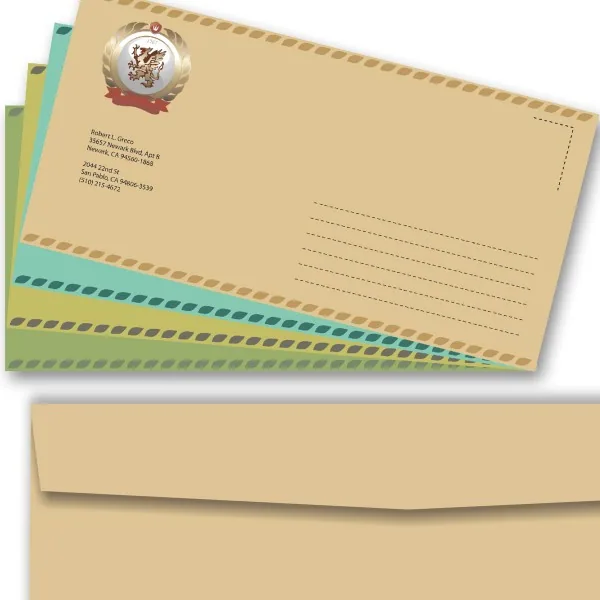
Free design proof on every custom order: no templates, no stock SKUs
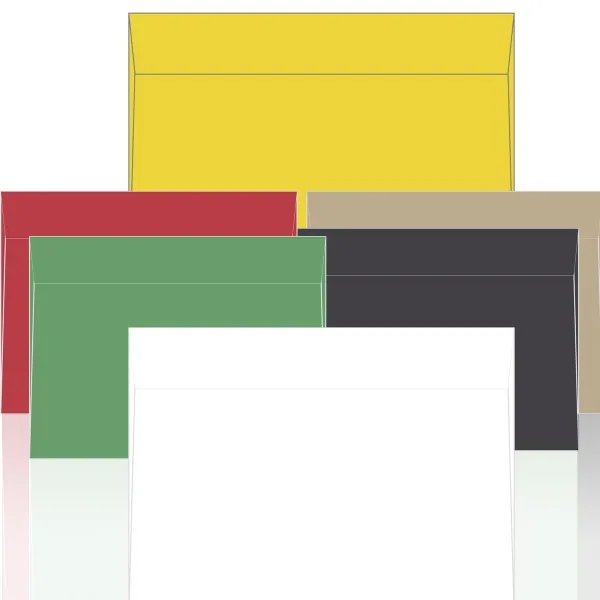
9 x 12 envelopes hold a standard 8.5" x 11" sheet, or several, completely flat, without the fold a #10 envelope requires. That matters whenever a document shouldn't arrive creased: contracts, resumes, photographs, presentation booklets and press kits all travel better flat than folded. Most 9 x 12 envelopes are made from a heavier kraft or white stock than a standard letter envelope, since they're often carrying more paper or something that benefits from a sturdier wrapper, and many include a clasp or self-seal closure built for repeated opening.
An estimator will reply within one business day.
A 9 x 12 envelope belongs to a different category of mailer than a folded letter envelope like a #10 or #9. Rather than being sized to wrap around a folded sheet, it's built to hold a full, uncreased 8.5" x 11" page, or several pages, with room to spare on every side. That's what makes it the standard choice whenever a document needs to arrive exactly as it left: a signed contract, a printed portfolio, a set of photographs, or a press kit that includes a folder, a one-sheet and a few loose inserts.
Construction differs from a letter envelope too. Most 9 x 12 envelopes open along the short end rather than the long edge, a style generally called "open-end," and many use a metal clasp in addition to or instead of an adhesive flap, since a clasp holds the envelope closed securely through handling without requiring the flap to be resealed if it's opened for inspection along the way. Stock is typically a heavier kraft or white paper than a standard envelope, both because it's often carrying more contents and because a large flat mailer takes more visible wear in transit than a small folded one.
Because the whole point of this size is delivering something flat, it turns up constantly in situations where creasing would be a problem: legal and real estate offices mailing signed documents, job applicants and recruiters exchanging resumes and portfolios, marketing teams sending press kits and media materials, and photographers or designers mailing printed samples of their work. A window can be added for return mail or for showing an address printed on an included cover sheet, and lamination or coating options exist for envelopes that double as a branded presentation piece rather than a purely functional mailer.
When ordering, weight is worth thinking through early, since a 9 x 12 envelope stuffed with more than a few sheets can push a mailing into a different postage bracket than a standard letter, and paper stock affects that weight directly. It's also worth deciding whether the envelope needs to hold its shape unsupported (useful for anything rigid like a small poster or a stack of photos) or whether a lighter, more flexible stock is fine for routine paperwork.
Envelope weight is doing two jobs: it decides how the piece feels when it arrives, and it decides whether the contents show through. A 24lb wove is the everyday business standard and hides a folded letter adequately. Step up to 28lb or 32lb where the contents are thicker, where a check or a dark-printed insert would otherwise ghost through, or where the envelope itself is meant to signal that something considered is inside.
Why can I see the contents through my envelopes? The stock is too light for what is inside. Either move up a weight or add a printed security tint to the interior.
The constraint that surprises people is that you cannot print wherever you like. Postal systems reserve areas of the face for the address block, the postmark and machine-readable barcodes, and artwork intruding on them can slow a mailing down or get it rejected. Everything else is available (the flap, the reverse, and the areas of the face outside those zones) which is why so much envelope design lives on the back.
Can I print across the whole front? No. The address block, postmark area and barcode zone have to stay clear. We will show those on your proof.
How the envelope is folded and glued determines what it is good at. A side-seam envelope has glue lines up both edges and lies flat and rigid, which is what business correspondence and machine insertion need. A diagonal-seam envelope folds from a single diamond blank with the seams meeting in the middle. Traditionally the more formal construction, and the one used for invitations and announcements.
Does the seam matter? For machine inserting, yes. Side seam feeds reliably. For a hand-addressed invitation, diagonal seam simply looks right.
Three closures, chosen against volume and by hand or by machine. Gummed flaps need moisture and are the cheapest. Fine for a machine, tedious by hand in quantity. Peel-and-seal has a release strip over a pressure adhesive and is far faster for hand assembly. Latex self-seal bonds only to itself, so envelopes can be stacked without sticking and closed with a press.
Which for a hand-stuffed mailing? Peel and seal, without hesitation. The extra cost per envelope is recovered in the first hundred you do not have to lick.
A 9″ × 12″ envelope holds one or many 8.5″ × 11″ sheets completely flat. That matters whenever a fold would damage or devalue the contents. Certificates, photographs, legal exhibits, presentation documents and anything that will be filed rather than read once. The construction is usually open-end, meaning the flap is on the short edge and contents load from the top.
Open end or booklet? Open end for filing and hand loading. Booklet, with the flap on the long side, if the contents are inserted by machine or you want a wider opening.
Ask for samples before committing. Show-through and how a stock takes a fold are both impossible to judge on screen.
A return address and a logo, printed directly. It is the cheapest way to make mail look like it came from an organization rather than from a printer, and on a business envelope it is often all that is needed.
Photographic and full-bleed artwork. Worth noting that full-bleed coverage is only truly achievable on custom envelopes printed flat before converting. On a pre-made envelope the seams and flap edges limit how far ink can reach.
Metallic foil pressed into the stock, most often on the flap or as a monogram. On a textured or laid envelope the combination of foil against the ribbed surface is the traditional formal treatment.
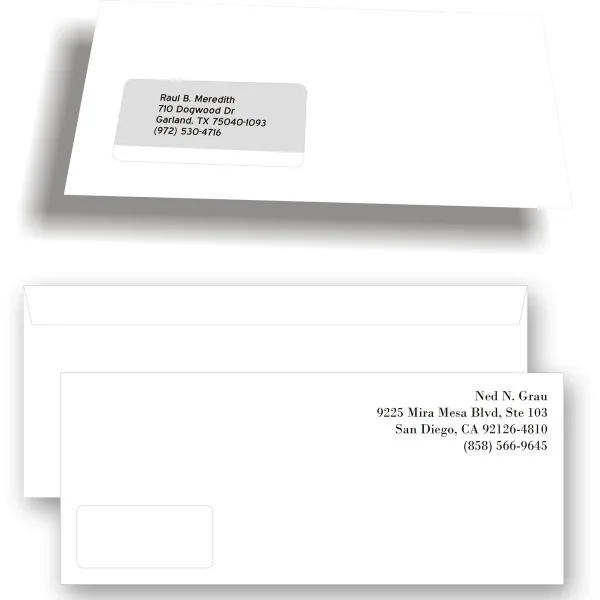
A die-cut aperture backed with a clear film so an address prints once, on the letter, and shows through. It removes a whole addressing step from a mailing, which is why it dominates invoicing and statements.
Same family, genuinely different jobs. Your current selection is highlighted.
| Envelope | From | Format | Order it when |
|---|---|---|---|
| #10 Envelopes | $220 | 4.125″ × 9.5″, letter in thirds | Standard US business correspondence |
| #9 Envelopes | $220 | 3.875″ × 8.875″, nests in a #10 | A reply envelope goes in the mailing |
| 9 x 12 Envelopes | $240 | Holds letter size unfolded | The contents must not be folded |
| DL Envelopes | $190 | 110mm × 220mm, A4 in thirds | Letters and invoices on A4 |
| C6 Envelopes | $180 | 114mm × 162mm, A4 in thirds | Cards and shorter ISO correspondence |
| Custom Envelopes | $190 | Printed flat, converted to size | No stock size fits, or you want full bleed |
Open end has the flap on the short edge and loads from the top, which suits hand filling and filing. Booklet has the flap on the long edge, giving a wider opening that machines and thick multi-page contents both prefer.
No. A flat 9 x 12 is a large envelope and is priced accordingly, generally more than a folded letter in a #10. If cost per piece dominates and the contents can be folded, a #10 is substantially cheaper to mail.
A clasp if the envelope will be opened and reclosed. A stiffener or rigid insert if the contents genuinely must not bend. A large flat envelope offers very little resistance to being folded in transit on its own.
Considerably more than a #10, since nothing is folded. The practical limit is the flap and the seams rather than the space, so if you are filling it near capacity, move up a paper weight.
Pricing for 9 x 12 envelopes starts at $240 and moves with quantity, size, material and finish rather than sitting on a fixed list. Setup is shared across the run, so the per-unit price drops steeply as the quantity rises: the gap between a few hundred and a few thousand is usually the significant one. Send the size, quantity and what it has to do and you get a firm figure back, not a range.
There is a practical minimum rather than a hard one. Every run carries artwork checks, a proof and a press setup, so a very small quantity of 9 x 12 envelopes prices poorly per unit even though we will still make it. If you are ordering a small batch, ask for pricing at two or three quantities at once: the curve usually shows that a modest increase costs very little more in total.
The clock starts when you approve the proof, not when the order is placed, which is the part most people are surprised by. You get a proof first: a digital proof showing the artwork with the clear zones and, where relevant, the window position marked. Nothing prints until you approve it. On a custom conversion the proof also shows the flat blank before folding. Turnaround after approval depends on the finish: anything laminated, foiled or die-cut adds a stage that cannot be compressed without causing problems later. Tell us the date you actually need them and we will work backwards from it rather than quoting a generic lead time.
Print-ready artwork with bleed and a safe margin, supplied as a PDF, AI or EPS. Photographic elements should be supplied at the resolution the finished size needs, not the resolution that looks sharp on screen. If your file is not print-ready, say so when you order. We would rather fix it before the proof than after the run.
Yes. Flat, unfolded letter size is the standard build, and the dimensions around it are yours to set. A size that sits efficiently on the press sheet often costs no more than a standard one, while an awkward proportion that wastes half the sheet does. Ask before you commit and we will tell you whether a small change to the dimensions saves a disproportionate amount.
In most cases they are the same product under a different name: the trade uses several terms for it depending on the region and the supplier. What actually defines this one is the build: holds letter size unfolded. Order it when the contents must not be folded. If you have seen it called 9 x 12 envelopes printing elsewhere, describe what it has to do rather than which name you found, and we will match the specification.
Yes. We provide free samples, and on 9 x 12 envelopes it is worth asking for one, because the difference between white wove and white wove, heavy is obvious in the hand and invisible on a screen. Most orders run on white wove, but ask for whichever you are weighing up. You also get a free design proof before anything goes to press, so nothing is printed that you have not seen.
The usual choices are one or two color, full color, foil stamping. Finish is not decoration on this product so much as a decision about how long it survives and how it reads in the hand, so it is worth choosing against the job rather than the budget. Tell us where the finished piece ends up and we will say which finish is doing real work and which is only adding cost.
Yes, and that is what almost every order here is. Nothing in this catalogue is a stock item: 9 x 12 envelopes are manufactured to the specification you give us, with your artwork on them. Send your logo as vector artwork where you have it, since that scales to any size without softening. If all you have is a low-resolution file, tell us and we will say what it needs before it reaches the press.
Yes, and a repeat run is simpler than the first one. We keep your approved specification on file, so a reorder skips the setup decisions and goes straight to production. If nothing about the artwork or the specification has changed, there is nothing to re-approve. Tell us the previous order and we will match it rather than starting the specification again.