Free design proof on every custom order: no templates, no stock SKUs

Pocket folders are the standard two-pocket business folder. A scored cover with a pocket glued on each inside face, sized to hold a stack of letter-size handouts without them sliding out. Free proof before production, on every order.
An estimator will reply within one business day.
A pocket folder is the plainest and most flexible folder format there is: a single cover scored down the center, with a pocket glued along the bottom and outer edge of each inside panel. That simple structure is what makes it useful across so many situations. It holds a loose stack of letter-size sheets flat and in order, without stapling or binding anything, and it opens flat again the moment someone needs to pull a document out.
9" x 12" is the standard trim size because it holds an 8.5" x 11" sheet without folding or creasing it, and it's the size most printers, presenters, and event staff default to without needing to specify anything unusual. Cover stock typically runs 10pt to 14pt, heavy enough to protect the contents and hold its shape through repeated handling but light enough to keep the finished folder from feeling bulky.
Because the format is so plain, most of what makes a pocket folder effective comes down to what's printed on the cover and how it's finished. Full-color printing on a coated stock, combined with gloss or matte lamination, is what turns a functional folder into something that reads as a deliberate piece of collateral rather than an afterthought.
The board decides how the finished folder feels in hand and how well it survives repeated use. 10pt to 12pt C1S is standard for a handout that's used once; 14pt is the point most people describe as "sturdy" without feeling like a binder cover. Above 14pt the folder gets harder to fold cleanly without cracking the coating at the score.
Which weight should I ask for? If it's a one-time event handout, 10-12pt. If it's a folder clients will keep on a desk, 14pt.
Full-color (4/4 or 4/0) covers most orders. Where a brand color has to match exactly across reorders (a specific corporate blue, a metallic) we run it as a Pantone spot rather than approximating it from CMYK. The inside panels are usually left unprinted or carry a light pattern, since the pockets and their contents cover most of that surface anyway.
Do I need to print the inside? Rarely worth it. Pockets and their contents cover most of the inside surface, so that budget is usually better spent on cover finishing.
Laminate is a film bonded to the printed sheet, not a varnish. It's what lets a folder survive being opened and closed dozens of times without the corners softening or the color scuffing. Gloss maximizes color pop for a folder that needs to catch attention on a table; matte reads as more restrained and hides fingerprints better in daily handling.
Do I need lamination at all? For a single-use event handout, no. For anything meant to be kept and reused (sales kits, onboarding packets) yes, it's the difference between a folder that lasts a week and one that lasts a year.
The center fold is scored, not just creased, before it's folded. Pressing a blunt rule into the stock so the fibers bend along a controlled line instead of cracking the coating at random. Skip the score on 14pt or heavier stock and the laminate visibly fractures along the spine on the very first fold.
Why does my folder crack at the fold? Almost always a missed or misplaced score on stock 14pt or heavier. Tell us the exact caliper and we'll set the score line for it.
Each pocket is its own die-cut piece, glued along the bottom and outer edge of the inside panel. The top and inner edge stay open so a stack of sheets slides in without resistance. A business card slit is a small additional die cut into one pocket, standard on most orders. A custom folder shape or a center pocket for a bound document both need their own die.
Can I get a deeper pocket for a bound booklet? Yes. Tell us the thickness of what needs to fit and we'll size the pocket die to it rather than using the standard depth.
Ask for samples of any stock on this list before committing to a run.
Maximizes color pop. The right call for a folder meant to stand out on a table.
Kills glare, hides fingerprints. Reads as more restrained and corporate.
A small die cut into one pocket. Standard on most orders, no added cost.
A rounded corner, an angled flap, or a fully custom silhouette, tooling carried into the first order.
Same family, genuinely different jobs.
| Comparison | File Folders | Certificate Folders | Custom Folders | |
|---|---|---|---|---|
| Starting price | $420 / 1,000 | $530 / 1,000 | $460 / 1,000 | $395 / 1,000 |
| Built for | Handouts & sales kits | Everyday document filing | Diplomas & awards | Non-standard specs |
| Pockets | Two side pockets | None (tabbed folder) | Certificate slit or corner slits | Your layout |
| Custom die | On request | No | No | Yes (any shape) |
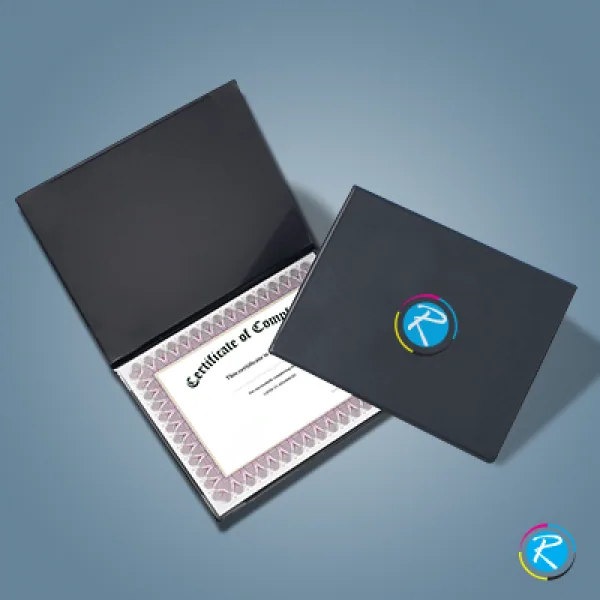
| Order it when | Standard branded collateral | You need everyday filing, not presentation | The contents are the point, not the folder | Nothing standard fits your spec |
50 folders on digital. Below about 500, cost per folder barely moves, since setup dominates. If you expect to reorder within the year, printing 1,000 in one run is usually cheaper than 250 four times.
Yes, at no extra cost on most orders. It's a small additional die cut into one pocket. Mention it when you request your quote so it's included in the die setup from the start.
Matte hides fingerprints and handling marks better over time; gloss shows them faster but has stronger initial color pop. For a folder that's meant to be reused (sales kits, onboarding packets), matte tends to hold up better visually after a few weeks in circulation.
Yes. A center pocket, sized for a bound booklet or a thicker stack of documents, is a different die but the same base folder format. Tell us the thickness of what needs to fit and we'll size it accordingly.
Yes. A free unprinted stock sample ships on request so you can check the caliper and lamination in hand before your artwork goes to proof.
Pricing for pocket-folders starts at $420 and moves with quantity, size, material and finish rather than sitting on a fixed list. Setup is shared across the run, so the per-unit price drops steeply as the quantity rises: the gap between a few hundred and a few thousand is usually the significant one. Send the size, quantity and what it has to do and you get a firm figure back, not a range.
The clock starts when you approve the proof, not when the order is placed, which is the part most people are surprised by. Turnaround after approval depends on the finish: anything laminated, foiled or die-cut adds a stage that cannot be compressed without causing problems later. Tell us the date you actually need them and we will work backwards from it rather than quoting a generic lead time.
Print-ready artwork with bleed and a safe margin, supplied as a PDF, AI or EPS. Photographic elements should be supplied at the resolution the finished size needs, not the resolution that looks sharp on screen. If your file is not print-ready, say so when you order. We would rather fix it before the proof than after the run.
Yes. The dimensions are yours to set. A size that sits efficiently on the press sheet often costs no more than a standard one, while an awkward proportion that wastes half the sheet does. Ask before you commit and we will tell you whether a small change to the dimensions saves a disproportionate amount.
In most cases they are the same product under a different name: the trade uses several terms for it depending on the region and the supplier. If you have seen it called pocket-folders printing elsewhere, describe what it has to do rather than which name you found, and we will match the specification.
Yes, and that is what almost every order here is. Nothing in this catalogue is a stock item: pocket-folders are manufactured to the specification you give us, with your artwork on them. Send your logo as vector artwork where you have it, since that scales to any size without softening. If all you have is a low-resolution file, tell us and we will say what it needs before it reaches the press.
Yes, and a repeat run is simpler than the first one. We keep your approved specification on file, so a reorder skips the setup decisions and goes straight to production. If nothing about the artwork or the specification has changed, there is nothing to re-approve. Tell us the previous order and we will match it rather than starting the specification again.
Yes. Regalo Print has been producing custom commercial print for businesses across the USA and Canada since 2008, and every order ships tracked. The tracking number reaches you the day the job leaves, not the day it arrives. If you are working to a fixed date, say so when you order so the production schedule is built around the delivery date rather than the other way round.