Free design proof on every custom order: no templates, no stock SKUs
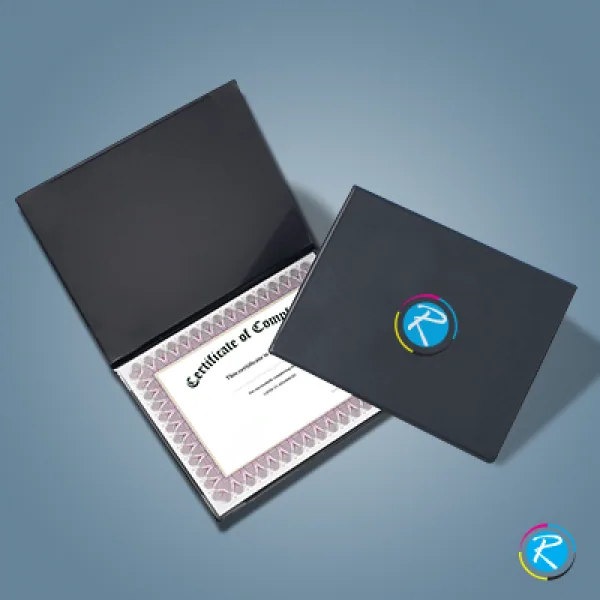
Certificate folders are built to hold and protect a diploma, award or certificate. With die-cut corner slits or ribbon-style slits that hold the paper in place without adhesive, so it stays flat and undamaged. They're commonly sized around 6 x 9 or 9 x 12 to match standard certificate and diploma paper, though custom sizes are available for oversized or unusually shaped awards. A durable cover stock keeps the piece from bending or creasing in transit, whether it's handed over at a graduation, an awards ceremony, or a corporate recognition event.
An estimator will reply within one business day.
A certificate folder is built around one specific job: holding a single certificate, diploma or award flat and protected, in a way that looks presentable the moment it's handed over. Rather than a full interior pocket meant to carry multiple loose sheets, most certificate folders use die-cut corner slits (small angled cuts near each corner of the interior panel) that the certificate slides into. That approach holds the paper securely without glue or tape, so nothing sticks to the certificate itself and it comes out undamaged whenever it's removed.
Sizing follows the certificate paper it's meant to hold, which is why 6 x 9 and 9 x 12 are the most common finished sizes. Matching typical certificate and diploma proportions with enough border to frame the document once it's inside. Custom sizes are available for oversized diplomas, unusually proportioned awards, or folders meant to hold a certificate alongside a small insert like a program or a photo.
Because a certificate folder is often the last thing someone receives at a graduation, training completion or awards ceremony, the cover tends to carry more design weight than a standard pocket folder. An organization's name, crest or logo, sometimes with foil stamping or embossing for a more formal finish. Stock is usually a heavier cover weight, commonly in the 12 pt to 14 pt range or a 100 lb cardstock, since the folder needs to hold its shape through handling, transport and eventual display or storage rather than get crushed in a stack of papers.
Some certificate folders add a small interior pocket or a business-card slit alongside the certificate slits, useful for pairing the award with a note, a transcript, or contact information from the issuing organization. If the certificate needs to be visible without opening the folder, a die-cut window on the cover is another option worth considering at the design stage, since it changes how the interior layout needs to be planned.
When ordering, it helps to know the exact certificate size in advance. A slit cut for a slightly different paper size can leave the document loose or make it difficult to slide in. Along with the quantity needed and whether the folders will be assembled and filled before an event or handed out blank for recipients to keep the certificate however they like.
The board decides how the finished folder feels in hand and how well it survives repeated use. 10pt to 12pt C1S is standard for a handout that is used once; 14pt is the point most people describe as "sturdy" without feeling like a binder cover. Above 14pt the folder gets harder to fold cleanly without cracking the coating at the score.
Which weight should I ask for? One-time event handout, 10-12pt. A folder clients keep on a desk, 14pt.
Full color (4/4 or 4/0) covers most orders. Where a brand color has to match exactly across reorders (a specific corporate blue, a metallic) we run it as a Pantone spot rather than approximating it from CMYK. Inside panels are usually left unprinted or carry a light pattern, since the pockets and their contents cover most of that surface anyway.
Do I need to print the inside? Rarely worth it, that budget usually does more on cover finishing.
Laminate is a film bonded to the printed sheet, not a varnish. It is what lets a folder survive being opened and closed dozens of times without the corners softening or the color scuffing. Gloss maximizes color pop for a folder that needs to catch attention on a table; matte reads as more restrained and hides fingerprints better in daily handling.
Do I need lamination at all? For a single-use event handout, no. For anything kept and reused, it is the difference between lasting a week and lasting a year.
The fold is scored, not just creased, before it is folded. Pressing a blunt rule into the stock so the fibers bend along a controlled line instead of cracking the coating at random. Skip the score on 14pt or heavier stock and the laminate visibly fractures along the spine on the very first fold.
Why does my folder crack at the fold? Almost always a missed or misplaced score on 14pt or heavier stock. Tell us the exact caliper and we set the score line for it.
A certificate folder holds a single sheet flat rather than a stack, so it uses slits instead of pockets. Corner slits take the four corners of the certificate; a center ribbon slit holds it along one edge. Either way the paper is held without adhesive, so the document can be removed and reinserted without damage, which matters when the contents are the thing being presented.
Corner slits or a ribbon slit? Corner slits hold more securely and suit a diploma that will be handled. A ribbon slit looks more formal on a presentation piece that stays in the folder.
Ask for samples of any stock on this list before committing to a run.
Maximizes color pop. The right call for a folder meant to stand out on a table.
Kills glare, hides fingerprints. Reads as more restrained and corporate.
A small die cut into one pocket. Standard on most orders, no added cost.
A rounded corner, an angled flap, or a fully custom silhouette, tooling carried into the first order.
Same family, genuinely different jobs. Your current selection is highlighted.
| Folder | From | Construction | Order it when |
|---|---|---|---|
| Pocket Folders | $420 | Two side pockets | Everyday branded handouts |
| Presentation Folders | $420 | Two pockets, premium finish | Pitches, proposals, client meetings |
| Legal Folders | $475 | Oversized pockets | Legal-length contracts and filings |
| Custom Folders | $395 | Your layout | Anything standard sizes cannot hold |
| Die-cut Folders | $440 | Custom cut outline | A folder shaped around your brand |
| Certificate Folders | $460 | Corner / ribbon slits | Diplomas, awards, ceremonies |
| File Folders | $530 | Reinforced tab, no pockets | Everyday document filing |
| Photo Folders | $370 | Print slit | Portrait and event photographers |
| Tri Panel Folders | $520 | Three panels | Multi-piece kits |
Corner slits hold all four corners and are the more secure option for a diploma that will be handled, posted or displayed. A single ribbon-style slit along one edge looks more formal and suits a presentation piece that stays in the folder. Both hold the document without adhesive, so it can be removed without damage.
Match the certificate, not the folder. 6″ × 9″ suits a half-size award certificate; 9″ × 12″ is standard for a letter-size diploma. Send us the exact finished size of the printed certificate and we cut the slits to hold it with the correct margin.
Yes, and on a certificate folder it is often the better choice. A blind emboss (an impression with no ink) reads as more formal than printing, and works particularly well on a heavier uncoated stock. Foil stamping is the other common option where the crest or logo needs to carry.
Assembled and scored, ready to receive the certificate. Unlike a pocket folder there is no gluing stage, so these arrive as finished folders rather than something you construct.
Pricing for certificate folders starts at $460 and moves with quantity, size, material and finish rather than sitting on a fixed list. Setup is shared across the run, so the per-unit price drops steeply as the quantity rises: the gap between a few hundred and a few thousand is usually the significant one. Send the size, quantity and what it has to do and you get a firm figure back, not a range.
There is a practical minimum rather than a hard one. Every run carries artwork checks, a proof and a press setup, so a very small quantity of certificate folders prices poorly per unit even though we will still make it. If you are ordering a small batch, ask for pricing at two or three quantities at once: the curve usually shows that a modest increase costs very little more in total.
The clock starts when you approve the proof, not when the order is placed, which is the part most people are surprised by. You get a proof first: artwork checked by a human, die line and score positions set to your caliper, proof issued free. Turnaround after approval depends on the finish: anything laminated, foiled or die-cut adds a stage that cannot be compressed without causing problems later. Tell us the date you actually need them and we will work backwards from it rather than quoting a generic lead time.
Print-ready artwork with bleed and a safe margin, supplied as a PDF, AI or EPS. Photographic elements should be supplied at the resolution the finished size needs, not the resolution that looks sharp on screen. If your file is not print-ready, say so when you order. We would rather fix it before the proof than after the run.
Yes. Retention slits is the standard build, and the dimensions around it are yours to set. A size that sits efficiently on the press sheet often costs no more than a standard one, while an awkward proportion that wastes half the sheet does. Ask before you commit and we will tell you whether a small change to the dimensions saves a disproportionate amount.
In most cases they are the same product under a different name: the trade uses several terms for it depending on the region and the supplier. What actually defines this one is the build: $460. Order it when corner / ribbon slits. If you have seen it called certificate folders printing elsewhere, describe what it has to do rather than which name you found, and we will match the specification.
Yes. We provide free samples, and on certificate folders it is worth asking for one, because the difference between coated cover c1s and coated cover c1s is obvious in the hand and invisible on a screen. Most orders run on coated cover c1s, but ask for whichever you are weighing up. You also get a free design proof before anything goes to press, so nothing is printed that you have not seen.
The usual choices are gloss lamination, matte lamination, business card slit. Finish is not decoration on this product so much as a decision about how long it survives and how it reads in the hand, so it is worth choosing against the job rather than the budget. Tell us where the finished piece ends up and we will say which finish is doing real work and which is only adding cost.
Yes, and that is what almost every order here is. Nothing in this catalogue is a stock item: certificate folders are manufactured to the specification you give us, with your artwork on them. Send your logo as vector artwork where you have it, since that scales to any size without softening. If all you have is a low-resolution file, tell us and we will say what it needs before it reaches the press.
Yes, and a repeat run is simpler than the first one. We keep your approved specification on file, so a reorder skips the setup decisions and goes straight to production. If nothing about the artwork or the specification has changed, there is nothing to re-approve. Tell us the previous order and we will match it rather than starting the specification again.
Yes. Regalo Print has been producing custom commercial print for businesses across the USA and Canada since 2008, and every order ships tracked. The tracking number reaches you the day the job leaves, not the day it arrives. If you are working to a fixed date, say so when you order so the production schedule is built around the delivery date rather than the other way round.